
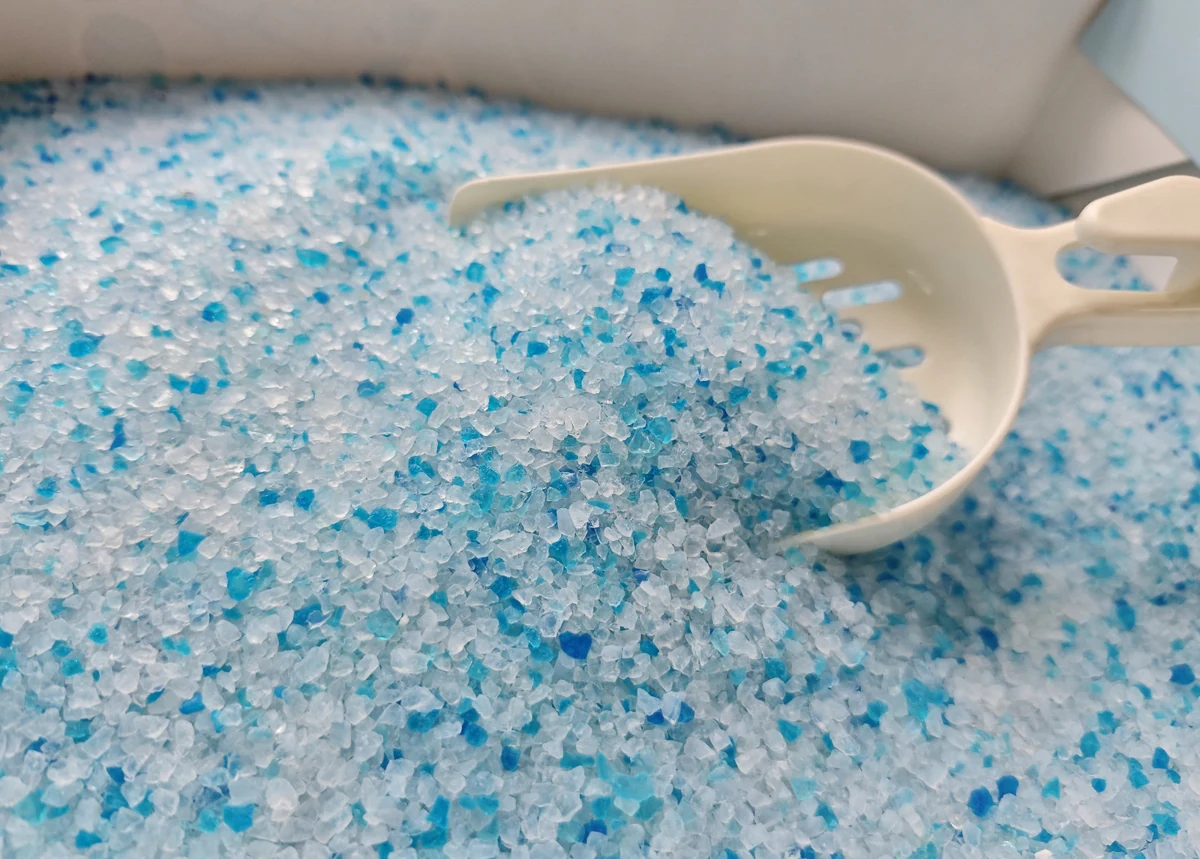
Crystal Cat Litter Odor Control: Science & Buyer Checks
Factory information · 2026-10-10
Crystal cat litter odor control involves porous silica gel and moisture uptake. Learn how to compare sample tests, maintenance and material science.
It is a useful option for keeping a litter tray manageable, but its performance depends on the material, how much waste enters the tray and how the litter is maintained. Here is what the research can—and cannot—tell us.
What causes litter-box odor?
The sharp smell often associated with a used tray includes ammonia. Microbial urease breaks down urea in urine and releases ammonia. Cat waste also produces sulfur-containing odor compounds derived from felinine, so ammonia alone does not explain every unpleasant smell. Robins and colleagues discuss these separate pathways in their study of litter malodor [1].
How the crystal structure helps
Silica gel is porous rather than a solid, impermeable crystal. Its internal surfaces provide sites where water can adsorb. Research by Huber and colleagues describes the role of surface silanol groups and shows that pore structure affects water sorption [2]. For litter, the practical takeaway is that moisture handling deserves attention alongside appearance and fragrance. This is a material-based explanation, not a measured odor-removal result for a finished cat-litter product.
Can silica gel capture ammonia?
There is experimental evidence that ammonia interacts with porous silica gel. Mallik and colleagues used a silica-gel coating in an optical ammonia sensor; exposure to ammonia changed the coating’s optical response [3]. That finding supports the adsorption mechanism, but the experiment tested a sensor under controlled conditions. It does not establish how much ammonia a bag of cat litter removes, or how long it will work in a household tray.
Why maintenance still matters
A tray that smells acceptable on day one can behave differently after repeated use. Check for persistent wet areas, waste left behind and a strong odor returning after cleaning. Follow the product’s instructions for litter depth, stirring where applicable and replacement. Remove solid waste promptly and clean the tray when changing the litter. If several cats share a tray, reassess the cleaning and replacement schedule rather than relying on a fixed number of days printed in an advertisement.
Odor control is not the same as antibacterial activity. A product claim about killing bacteria requires its own evidence. Likewise, an ammonia result cannot automatically prove control of sulfur-related odors.
What buyers should ask a manufacturer
When comparing crystal cat litter, request a clear specification and samples of the actual grade offered. Evaluate moisture uptake, particle size, dust, handling and odor performance separately. For an odor-control test, agree on the waste or test liquid used, loading rate, temperature, humidity, test duration and comparison product. A result without these conditions is difficult to interpret.
At RUIDA SILICA, buyers can discuss crystal cat litter specifications and packaging requirements directly with our factory. For samples and a specification discussion, contact alexsun@ruidasilica.com. Published research provides background on mechanisms; product-specific performance claims should be supported by tests on the supplied formulation.
Research references
[1] Robins LI et al. Control of felinine-derived malodor in cat litter. Journal of Feline Medicine and Surgery, 2022. https://doi.org/10.1177/1098612X211009136
[2] Huber L, Paz Comesaña S, Koebel MM. The influence of the ammonia concentration and the water content on the water sorption behavior of ambient pressure dried silica xerogels. Journal of Sol-Gel Science and Technology, 2020. https://doi.org/10.1007/s10971-020-05349-1
[3] Mallik AK et al. Silica Gel Coated Spherical Micro resonator for Ultra-High Sensitivity Detection of Ammonia Gas Concentration in Air. Scientific Reports, 2018. https://doi.org/10.1038/s41598-018-20025-9
Buyer questions about crystal litter odor control
Does a silica gel research paper prove the performance of a finished litter?
No. A paper can support a material mechanism while using a different sample and test setup. Ask for the actual supplied formulation, test conditions and report before approving a product-specific claim.
Should fragrance and odor removal be compared as one result?
No. Evaluate the unscented base and any proposed scented formulation separately. Record moisture behaviour, perceived scent and measured odor results as different observations.
Request crystal cat litter samples
Crystal cat litter specifications
Robins et al.: cat litter malodor research