
Type A, B and C Silica Gel: Uses, Markets and RUIDA Manufacturing
Factory information · 2026-11-03
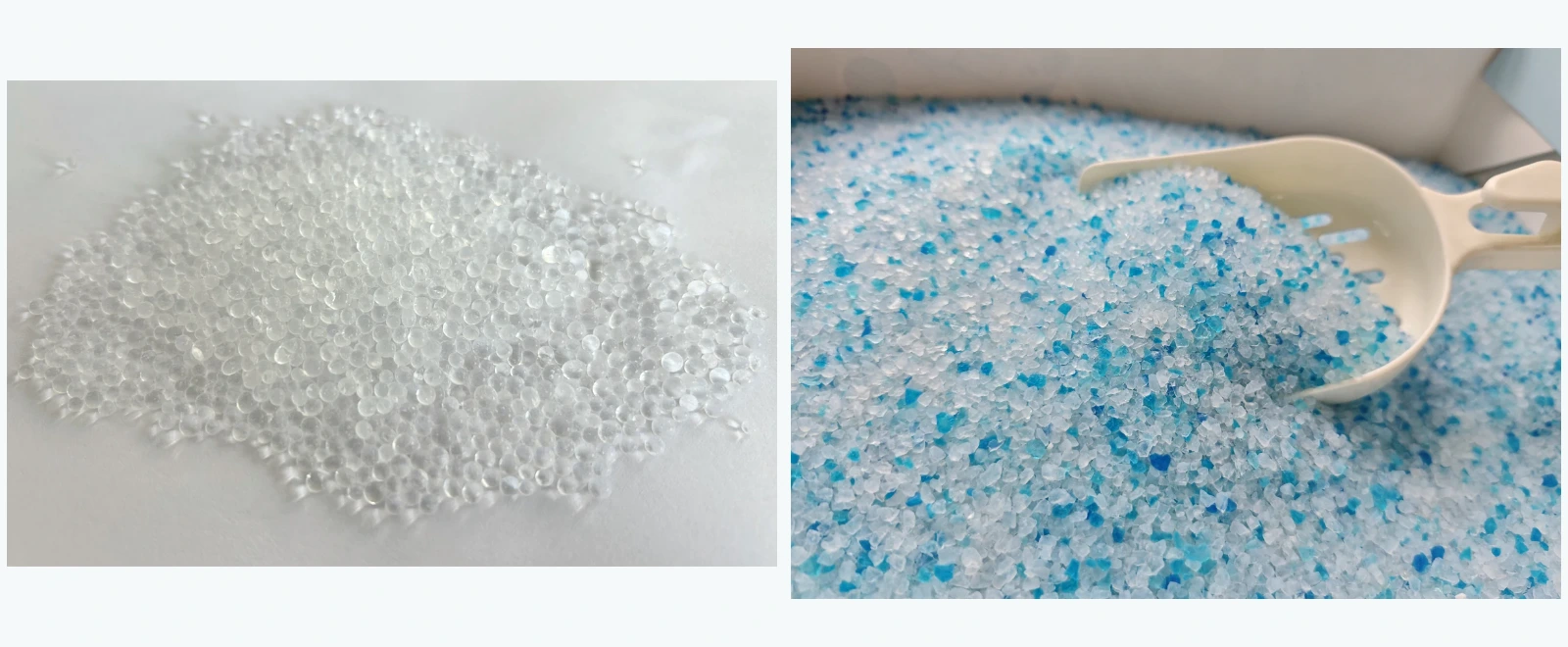
Cover photos, left to right: RUIDA Type A spherical silica gel and Type C crystal cat litter.
RUIDA manufactures Type A, Type B and Type C silica gel in spherical and granular (lump) forms. These materials serve different purposes: moisture protection in packaging, humidity management, crystal cat litter, industrial adsorption and carrier applications. Selecting the right product means matching its pore structure, particle form and specification to the conditions in which it will actually work.
This guide explains how the three types differ, where RUIDA products fit, how demand varies across customer groups and regions, and why Shandong has developed a concentrated silica gel manufacturing supply chain.
1. Pore structure and particle size: two different decisions
Silica gel is a porous, amorphous silica material. Its performance depends on the internal pore network and surface properties as well as the size and shape of the finished particles. Pore diameter describes the openings inside a particle; pore volume describes the internal void volume available per unit mass; particle size describes the outside dimensions of the bead or granule.
Two products with the same particle-size range can therefore perform differently. A small bead is not automatically fine-pore silica gel, and a large granule is not automatically coarse-pore material. RUIDA first identifies the appropriate Type A, B or C material, then confirms the particle form, grading and application requirements.
Type A is fine-pore silica gel, commonly selected for drying and moisture protection, especially where adsorption at relatively low humidity matters. Type B has a pore structure between fine-pore and coarse-pore materials and is used in suitable humidity-management, liquid-adsorption and carrier applications. Type C is coarse-pore silica gel and includes the material route used for RUIDA crystal cat litter, alongside suitable industrial adsorption and carrier grades.
The letters are product classifications, not a ranking from lower to higher quality. The best choice is the material that meets the required operating conditions and acceptance criteria.
2. RUIDA Type A silica gel: effective moisture control at the required humidity
Type A silica gel is an important material for packaging desiccants. Moisture-sensitive components, instruments, machinery parts and other goods may need protection during storage and transport. A suitable desiccant helps control water vapor inside the package; its performance must be assessed together with the package itself.
RUIDA Type A spherical silica gel is available for appropriate sachet, canister and industrial filling applications. Buyers should assess particle-size distribution, bead integrity, strength, abrasion and compatibility with their dosing equipment. RUIDA Type A granular silica gel offers a lump-form option for suitable bagged desiccants and industrial applications, with screening consistency, fines and packaging compatibility confirmed for the order.
Type A spherical silica gel: product details
Type A granular silica gel: product details
Why maximum water uptake is not enough
A maximum adsorption figure measured at high relative humidity does not describe how a desiccant will perform at a lower target humidity. For moisture-sensitive goods, the useful question is how much water the selected material can take up under the intended temperature and humidity conditions while maintaining the required protection.
The moisture load includes water present at packing, moisture released by the goods and packaging, and water vapor entering through the package over time. Storage duration, seal integrity and the barrier properties of the packaging all matter. Increasing desiccant quantity cannot compensate indefinitely for unsuitable packaging.
A useful preliminary relationship is: desiccant mass equals the expected moisture load divided by the usable adsorption capacity under the chosen conditions. This is a sizing concept, not a substitute for package testing; initial moisture in the desiccant and an appropriate design margin also need to be considered.
For converters, RUIDA Type A specifications should therefore address both application performance and processing consistency. A lower price per tonne may not produce a lower cost per protected package if more material is needed, dosing becomes inconsistent or excessive fines affect sealing and cleanliness.
3. RUIDA Type B silica gel: humidity response and carrier compatibility
RUIDA produces Type B silica gel in both spherical and granular forms. Its intermediate pore structure supports applications such as humidity management, liquid adsorption and suitable fragrance or catalyst carriers. The exact grade must be evaluated with the customer's operating conditions or formulation.
Humidity management
Some applications need to moderate humidity changes within an enclosure. In that case, the relevant information includes adsorption and desorption behavior over the intended humidity range, material conditioning before use, enclosure leakage and the amount of silica gel installed. A single maximum-uptake number does not describe the response of the complete system.
Carrier applications
For a liquid or fragrance carrier, buyers should assess loading capacity, distribution of the liquid, free-flowing behavior after loading, leakage and stability during storage. A catalyst carrier requires its own assessment of pore structure, impurities, mechanical properties and process compatibility. Results obtained with water cannot automatically be applied to a different liquid or active ingredient.
RUIDA Type B spherical and granular products can be discussed against these specific requirements. A productive development sequence is to identify the medium and intended function, evaluate samples with the actual formulation, agree measurable acceptance criteria and then confirm the production specification. Repeatability across deliveries is more useful than an unusually high result from one sample.
Discuss Type B spherical or granular silica gel
4. RUIDA Type C silica gel: from porous material to crystal cat litter
RUIDA produces Type C silica gel in spherical and granular forms. Crystal cat litter is an important application of RUIDA's Type C material. Delivering a satisfactory litter product, however, requires more than selecting a pore type: absorption behavior, particle grading, fines, handling and packaging all influence the finished result.
Liquid absorption and repeated use
Packaging desiccants primarily encounter water vapor, while litter encounters liquid directly. Vapor-adsorption data should not be treated as a complete measure of litter performance. Evaluation should consider the rate of uptake after a defined liquid addition, the condition of the litter after repeated additions, distribution through the bed and signs of local saturation.
A product with high eventual capacity may still need improvement if liquid remains locally concentrated during use. Comparing samples requires a consistent liquid, dosing schedule, litter quantity and test procedure.
Particle grading, strength and dust
Particle size and shape influence bed formation, handling, tracking and contact under the cat's paws. Mechanical integrity matters because a product experiences filling, transport, unloading and pouring before it is used. Fines should therefore be evaluated both in the original sample and after representative handling or transport simulation.
RUIDA spherical and granular Type C products can be assessed against the customer's intended litter format. Shape alone does not establish comfort, dust performance or acceptance; the finished specification and use evaluation are what matter.
Odor performance needs its own evaluation
Water uptake and odor control are connected aspects of litter use, but they are not interchangeable test results. Odor evaluation should define the test conditions and take account of litter depth, cleaning practice, number of cats and ambient conditions. Claims should match the tested formulation and instructions.
Packaging protects usable capacity
Silica gel can take up moisture during storage. The barrier properties of the bag, seal quality and warehouse conditions help determine its moisture state on arrival. Retail packaging is therefore part of product performance as well as brand presentation.
RUIDA's cat litter range includes standard crystal cat litter and separately specified functional products. Clumping formulations and pH-monitoring products need their own performance evaluation and instructions; those functions do not follow from the Type C designation alone. Health-monitoring color responses support preliminary observation and do not replace veterinary assessment.
Explore RUIDA crystal cat litter
Explore the cat litter product range
Discuss private-label packaging
5. Type C for industrial adsorption and carrier applications
Coarse-pore silica gel also has applications in suitable gas drying and purification, oil treatment and catalyst-carrier processes. RUIDA Type C spherical and granular materials should be selected against the medium, temperature, pressure, flow conditions and regeneration requirements of the particular system.
Industrial buyers need to distinguish adsorption performance from mechanical service performance. A material may achieve the desired uptake in a laboratory sample but still need assessment for attrition, packing behavior or performance after regeneration. The acceptance plan should define both the chemical or adsorption duty and the required physical properties.
Cat litter grades and industrial grades should be specified separately. Neither a shared Type C label nor a similar appearance demonstrates that two products are interchangeable.
6. Spherical versus granular silica gel: compare the whole process
RUIDA's ability to produce spherical and granular forms across Types A, B and C allows buyers to address both material performance and handling requirements.
For automatic dosing, evaluate the size distribution, flow behavior and repeatability of the delivered mass. For transport, compare particle breakage, abrasion and fines after handling. For industrial beds, assess packing, void space, flow distribution and pressure drop under the intended conditions. For litter, assess particle feel, rolling or tracking behavior and the condition of the product after shipment.
These properties interact. A change in particle grading may affect both filling behavior and airflow; a change intended to improve strength may also require an adsorption check. Buyers should compare spherical and granular samples under the same procedure rather than assuming one form is universally superior.
7. Market distribution: three distinct purchasing systems
Silica gel markets are best understood through their end uses. The producer, converter, brand owner and final customer may be located in different regions. Material manufactured in Shandong may be repacked elsewhere and sold through a regional distributor or an overseas retail brand.
Packaging and manufacturing customers
Desiccant converters, packaging companies, electronics manufacturers and exporters buy moisture protection and dependable processing. In China, manufacturing regions such as eastern and southern China provide customer-development opportunities. Across East Asia, Southeast Asia and South Asia, outreach can follow manufacturing and packaging supply chains. These are application-based sales directions, not a statistical ranking of regional silica gel consumption.
RUIDA Type A silica gel fits discussions about raw-material supply, dosing compatibility, package validation and regular delivery. Customer qualification should begin with the product being protected and its storage conditions, not simply with the climate of the destination country.
Pet brands, importers and retailers
North America and Europe are relevant markets to assess for crystal cat litter, alongside other regions with established pet-product channels. Within each market, brands and importers have different retail prices, packaging formats and consumer expectations. A private-label buyer needs a repeatable finished product, clear labeling, reliable replenishment and a workable landed cost.
RUIDA Type C litter projects can therefore progress from sample evaluation to particle and packaging confirmation, followed by agreed inspection and shipment arrangements. The relationship between first samples and repeat orders is central to brand consistency.
Industrial and specialist-material customers
Industrial adsorption and carrier customers buy performance within a defined process. Their priorities include technical compatibility, validation, traceability and stability across replacement cycles. RUIDA Type B and Type C products, together with suitable Type A grades, can be evaluated for these requirements. Geography matters for delivery and service, but the operating specification determines whether a material qualifies.
8. Why Shandong has a concentrated silica gel supply chain
Shandong is a major Chinese manufacturing cluster for inorganic silica gel. Its position reflects an established network of raw-material production, silica gel processing, equipment expertise, grading, packaging and trade services.
Silica gel manufacture typically involves raw-material preparation, gel formation, aging, washing, drying and finishing. These stages are connected: pore structure develops through the production process, soluble residues must be controlled, and the final moisture state and particle grading must suit the intended product. Screening alone cannot turn one pore type into another.
RUIDA's connection from sodium silicate to finished products
RUIDA's manufacturing chain connects sodium silicate production with silica gel manufacture and cat litter and desiccant processing. Sodium silicate is an important input in silica gel production. Coordination between the raw-material and finished-product stages provides a practical basis for discussing material requirements, processing and delivery with one manufacturing team.
Learn about RUIDA's integrated manufacturing
Process knowledge and local support
The commercial value of a manufacturing cluster lies partly in accumulated experience: maintaining equipment, controlling production conditions, investigating deviations and coordinating supporting services. Washing and drying require attention to product quality, resources and operating consistency. Capacity alone does not explain whether the agreed quality can be repeated.
Finishing and logistics connect production with buyers
Grading, dust removal and packaging convert base materials into customer-specific supply formats. Regional manufacturing and port logistics also support export coordination. Actual delivery costs still depend on factory location, packaging, route and order size; the benefit is the availability of connected services rather than an automatic lowest-price guarantee.
For RUIDA customers, this supply-chain setting supports a coordinated discussion covering Types A, B and C, spherical or granular forms, sample requirements and packaging. Buyers should evaluate the actual specification, inspection plan and delivery record alongside the supplier's location.
9. A broader RUIDA range with clear product boundaries
RUIDA's portfolio lets customers begin with the application and then choose the relevant material. Type A spherical and granular silica gel address suitable drying requirements. Type B covers appropriate humidity-management and carrier duties. Type C serves RUIDA crystal litter and separately specified industrial applications.
Related products should retain their own specifications. Indicating silica gel needs a defined indicator system and instructions. Clumping or monitoring litter requires evaluation of its formulation. Sodium silicate and sodium sulfate are separate industrial-material categories, not substitutes for finished silica gel.
10. Compare cost in use, then define the enquiry
Price per tonne is only one purchasing measure. For desiccants, compare the cost of protecting each package over the required period. For litter, compare landed cost, actual use and the consistency needed for repeat sales. For industrial materials, include replacement frequency, regeneration and maintenance requirements.
Volume-based litter packs also require attention to bulk density. Pack mass equals the stated volume multiplied by the measured bulk density, using consistent units and a defined filling method. Two bags with the same stated volume may therefore differ in weight, shipping economics and use performance. Those differences should be evaluated together rather than judged from weight alone.
To request a relevant sample and quotation from RUIDA, provide the intended application; Type A, B or C if already known; spherical or granular form; particle-size range; moisture, adsorption, strength or dust requirements with test methods; packaging and net quantity; destination; and expected order volume. For industrial use, also describe the medium and operating conditions.
RUIDA manufactures Type A, Type B and Type C silica gel in spherical and granular forms. Share your application, specification and packaging requirements with our team to discuss material selection, samples and bulk or private-label supply.